
Nordic Walks

Upcoming Nordic walks

 Clamart(92)
 Jumièges(76)
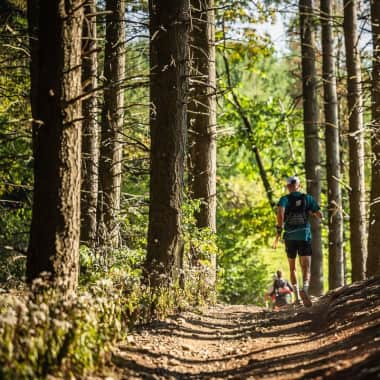 Cublize(69)
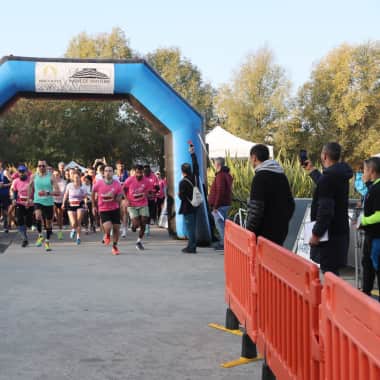 Nanterre(92)
Walking shifts into second gear
Born from Finnish cross-country skiing, Nordic walking engages the whole body with two poles.
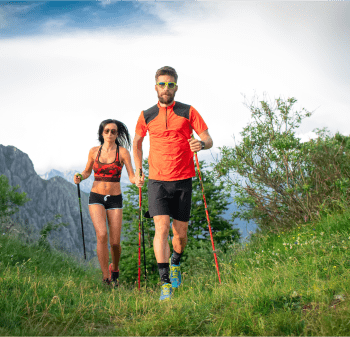
Nordic walking. Two words, one obvious fact: here, you walk fast, you walk hard. You plant two poles behind you, push through your arms, and your whole body joins the motion. Your upper body works just as much as your legs, which clearly sets the discipline apart from a Sunday stroll 💪. The sport was born in Finland, when cross-country skiing athletes were looking to keep their kick once the snow had melted. Scandinavians call it sauvakävely, walking with poles: a Nordic DNA that has traveled the world ⛷️.
Under this name, several ways of practicing coexist. The health-focused version takes its time, is enjoyed in a group, and bets on fresh air and consistency. The sporty version turns it up a notch, picks up the pace, and targets the clock. Your body benefits everywhere: arms, back, core, legs—everything is engaged, without the harsh impact of running. In a Nordic walking race, you’ll most often come across 5 or 10 km distances, perfect for getting started without pressure. The most die-hard head for long distance, sometimes even ultra, where endurance has the final say. Carried by millions of participants across Europe, the discipline is practiced year-round, with a peak in spring and then in autumn 🌿.
In France, Nordic walking heads out into nature terrain, far from the concrete. Near Paris, Nordic'92 plants its poles in the woods of Clamart, a dedicated gathering that brings together walkers from the Hauts-de-Seine 🌲. Then head west, with the Nordic Walking Torche based in Plomeur, in the heart of the Pays Bigouden.
Because Nordic walking is mainly played beyond borders. Poland leads the way 🇵🇱. In Finland and Germany, it borders on a national sport, practiced by entire families. Most world championships are held on Polish soil, from one region to another, from the Baltic coast to mountainous Silesia. On the Baltic Sea, the Coastal Race of Ustronie Morskie lays out its kilometers facing the dunes, sea air included. Closer to Warsaw, the Dycha d'Otwock mixes road and poles in a friendly, easygoing atmosphere, open to all levels. The circuit doesn’t stop there: the World Cup travels from Italy to Slovakia, all the way to Moroccan stages under the sun of Agadir.
The story comes down to a few stubborn pioneers. As early as 1966, Finnish teacher Leena Jääskeläinen introduced pole walking into her PE classes. In 1997, her compatriot Marko Kantaneva put the method down on paper and gave the discipline its name as well as its identity 🔥. Since then, the walking planet has found its heroes, like the Spaniard Tony Vázquez Baluenga, a world reference in very long distances. The spirit, however, doesn’t change from one country to another: you rarely set off alone, you match your pace to the group, and the coffee shared after the effort matters just as much as the kilometers ☕. Browse the Nordic walking calendar, and spot the outing that fits your level ✨.
 See all races
Will you pick short or long distance?
All Nordic walks by month
More places are waiting for you




























Other disciplines are waiting for you






This could also be of interest to you


A next-gen platform helping sports enthusiasts of all levels discover territories and heritage through races tailored to them.
Made in France, between Lyon and Nantes