
How to prepare for the EcoTrail Paris
Salomon Ecotrail Paris
How to prepare for the EcoTrail Paris?
How to prepare for the EcoTrail Paris? From choosing your distance to specific training, here’s the plan to reach the Eiffel Tower in top form.
The EcoTrail Paris, a trail race like no other 🗼
Head to Île-de-France, where there are no mountains or volcanoes: the terrain mixes state forests, the Seine riverbanks, and Parisian pavement, for an unusual trail running format right in the heart of the capital 🌳 .
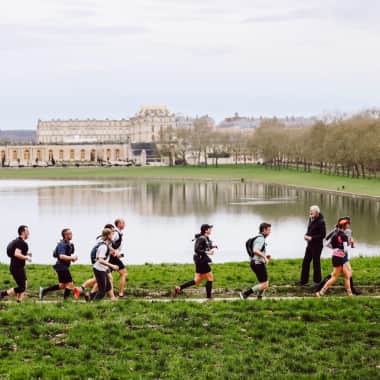
The route crosses the Versailles state forest, the Bois de Clamart and the Meudon forest, before heading back up along the Seine to the Pont d’Iéna. The most iconic finish takes place on the first floor of the Eiffel Tower, a monument everyone knows, but that few runners reach with legs that heavy 💪 .
The event holds recognized labels in the sport, including UTMB Qualifier, ITRA and FFA National. Enough to make the EcoTrail Paris a credible springboard toward other more demanding ultra-trails.
Which distance to choose and how to structure your training 🏃
Nine formats make up the EcoTrail Paris, so there’s something for everyone.
- Discovery formats (10 to 20 km)
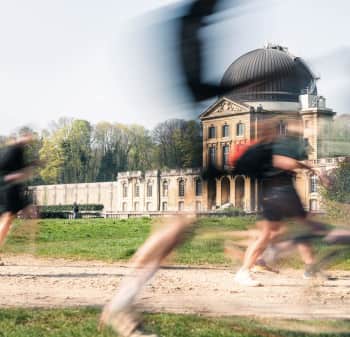
Typically starting from the Domaine de Saint-Cloud or the Meudon Observatory, with limited elevation gain and a route that’s 90% natural. A 6 to 8-week training block, with two runs per week including one hill session, is more than enough to tackle these distances with confidence.
- Intermediate formats (30 and 45 km)
The “Trail 45 km” starts from the gardens of the Palace of Versailles, while the “Trail 30 km” starts from the Meudon Observatory. Plan for 10 to 12 weeks of preparation, with a weekly long run gradually building up to 25–30 km, and strength training to handle the switchback trails in the Meudon forest.
- Ultra formats (80 and 120 km)
The “Trail 80 km” has been the event’s historic distance since 2008, starting from the Élancourt Hill. New for 2026: the “Trail 120 km”, starting from the Château de Rambouillet and crossing the Chevreuse Valley. For these formats, plan on 4 to 6 months of specific training, with long runs regularly exceeding 50 km, and a solid fueling strategy.
Race day: mandatory gear and finish strategy 🎒
The mandatory kit is standard but non-negotiable across all distances: emergency blanket, fully charged phone and ID. Add a sufficient water reserve: aid stations punctuate the race, but they never replace your own proper hydration 💧 .
On the longer distances, stay sharp for the final turnaround along the Seine: that’s often where bodies start to crack, just before the climb back up to the Pont d’Iéna. A progressive pace, planned from the start, helps avoid the classic slump 10 km from the finish.
Facing the Iron Lady tower
Between Île-de-France forests and a finish line at the foot of the Eiffel Tower, the EcoTrail Paris remains an ideal learning ground before aiming for something more demanding. Choose your distance, lock in your training plan, and book your bib 🏁 .
This could also be of interest to you
 Paris(75)
 Paris(75)






A next-gen platform helping sports enthusiasts of all levels discover territories and heritage through races tailored to them.
Made in France, between Lyon and Nantes