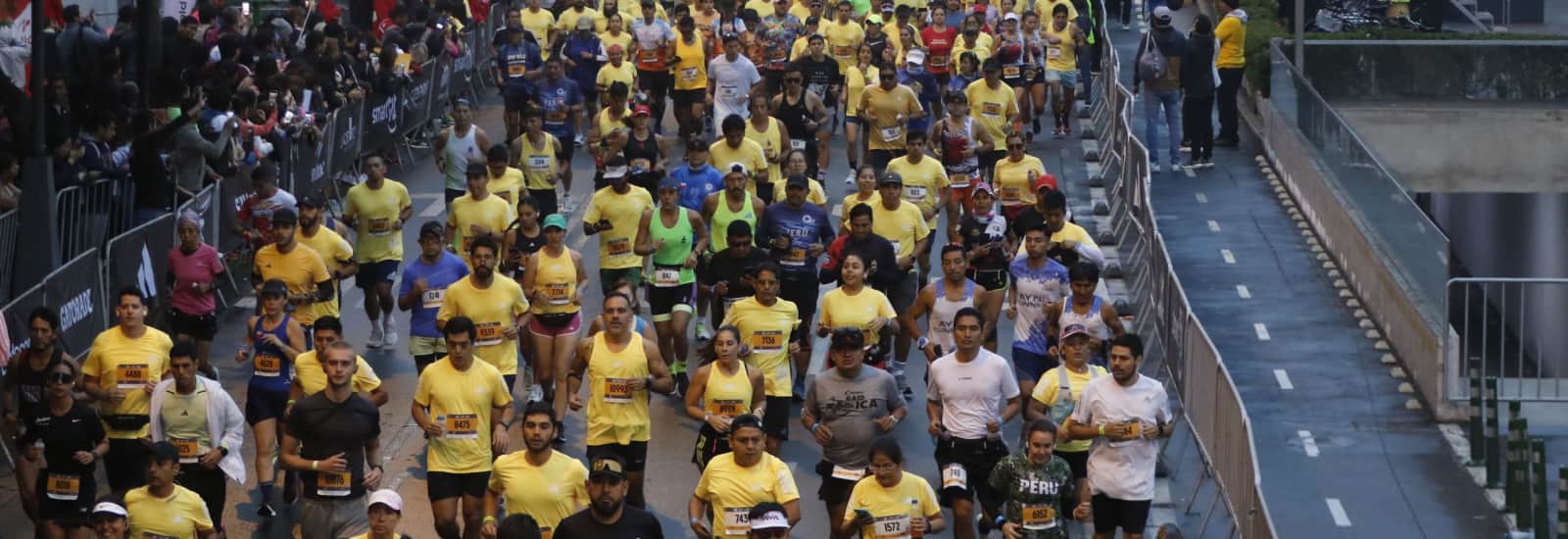
Lima Marathon (Lima42K) 2027
- Next event : End of May 2027
- Last event : Sun, May 24, 2026

The event in a few words
The Lima 42K, officially the Lima Marathon, is kind of the final boss of Peruvian marathons 🦙. Not just in Lima, no: in the whole country. And in a part of the world where the outdoors is already seriously stacked (hello Machu Picchu, the Amazon and the Andes), it sets the scene. Every year in May, Lima hits pause and lets over 20,000 runners stream through its most stylish neighborhoods 🗺️.
It all starts in 2009, at the famous Pentagonito 🏛️. Yes, the Peruvian Army HQ, local pentagon edition. Same concept as the American Pentagon, but with noticeably more ceviche nearby. That first edition welcomed no fewer than 7,000 runners. Honestly solid for a launch 🚀. At the helm: the Perú Runners association, which would grow the event for more than fifteen years. In 2013, the vibe changed: heading to San Isidro, the chic, diplomatic district 🏙️, but in recent years the organizers have wanted to tweak the route to offer runners other perks 😍. The start now takes place around Miraflores 🤩, and honestly, it’s hard to beat that setting. It’s a neighborhood overlooking the Pacific Ocean, with cliffs, well-kept parks, and that feeling that there’s always a bit of air moving through 💨. The kind of place where, even without running, you’d want to go for a stroll 🚶. Here, you’re running through it, so of course it helps 😅.
Pretty quickly, the course pulls you onto wide arteries like Avenida Arequipa. It’s straight, it’s long, it flows well 🏎️. You pass through Lince, a more residential area—less postcard-perfect, but part of the real backdrop of the city 🌆. And then, gradually, you head back toward what’s kind of the signature moment: the Malecón de Miraflores 🌊. Here, we’re not going to pretend: it’s pretty darn stylish. You run above the ocean, with open views, cliffs beneath your feet and the Pacific stretching out in front of you. It’s not the kind of section where you only look at your watch ⌚️. You lift your eyes a little, and it feels good 👍. The marathon is run in two 21 km loops 🔂, which lets you spot the landmarks, anticipate what’s coming, and sometimes tell yourself, “ok, I’ve already done this, I can get through it.” The profile is generally fast 🛹. Nothing very technical, no big surprise climb. Just a few small variations to avoid the treadmill effect. It’s the kind of course where you can focus on your race without fighting the terrain every five minutes. And for a marathon, that’s not a minor detail 🤪.
Another thing that clearly works in its favor: the weather 🌫️. Lima has a rather unique climate, somewhere between desert and ocean 🏜️. In May, you often get that famous coastal fog, the garúa, which creates a fairly uniform gray sky. Said like that, it doesn’t sound dreamy, but in reality, it’s more of a blessing 🤲. Temperatures around 18–20°C, no blazing sun, no crushing heat that would melt you like ice cream in the sun 🍦. Just soft light and stable conditions. For long running, it’s honestly comfortable ☁️. What’s also interesting is the overall vibe of the race. There’s a serious, well-organized side to it, with timing handled by ChronoTrack (the same ones as at the New York City Marathon), so everything’s squared away 🤓. But alongside that, you can feel there’s real care for who’s taking part. Over the past few years, the event has added more categories for athletes with disabilities, in a pretty natural way—not forced into the spotlight, but clearly present 🙌. On the start line, you’ll find a striking mix: local runners, of course, plenty of internationals too, and different levels coexisting without any issues 🙌. Some come to perform, others to live the experience. And you see that in the results as well. For example, in 2025, Kenyan Dominic Letting took the men’s title 🏆, while Ethiopian Aberash Demisse won the women’s race. And in the middle of all that, local runners like Walter Nina holding the pace on home soil 🇵🇪. It creates an interesting balance between international level and local roots 🌍.
As for formats, nothing complicated: 42 km, 21 km or 10 km 👟. Everyone can find their distance. The routes are certified by World Athletics and AIMS, so there’s no doubt about the measurements. If you’re coming for a time, the framework is there. If you just want to run somewhere nice, that works too. And then there’s Lima all around it 🏙️. A huge city, but with tons of character. You move pretty quickly from modern to more historic, from calm to super lively 🎉. The historic center, around Lima’s Plaza Mayor, has that colonial feel with its wooden balconies and its grand squares. And a few kilometers away, the vibe changes completely: over in Barranco, for instance, you find something more laid-back, more artistic (bars, galleries, music), an atmosphere that makes you want to hang around a bit longer than planned 🎶. It’s often where the legs recover while the mind keeps enjoying things 😌. And of course, there’s the food 🍽️. Impossible to miss the ceviche 🐟. It’s not just a typical dish, it’s practically an institution. After an effort like that, it’s as much part of the scenery as anything else 🗺️.
In the end, the Lima 42K offers a pleasant course, a balanced atmosphere, fairly mild weather, and a city that’s worth lingering in for a bit. And maybe that’s what really makes it so enjoyable: you can take it seriously without taking yourself too seriously 😉.
A distance for every taste
MarathonTOP
Half Marathon
- End of May 2027
- 1 loopx42.195 km
Half Marathon
Road Running- End of May 2027
- 1 loopx21.0975 km
Hotels near the race
A next-gen platform helping sports enthusiasts of all levels discover territories and heritage through races tailored to them.
Made in France, between Lyon and Nantes