Grampians Peaks Trail 2026
- Next event : 5 Thu ➜ November 8, 2026Date confirmed

The event in a few words
Have you ever heard of a 100-mile trail race in Australia? The Grampians Peaks Trail 100 Miler (or GPT100 for those in the know) is exactly that. An Australian race lost in a national park that looks like another planet, held on a hiking trail that wasn’t built for a race, but to honor a land 🇦🇺.
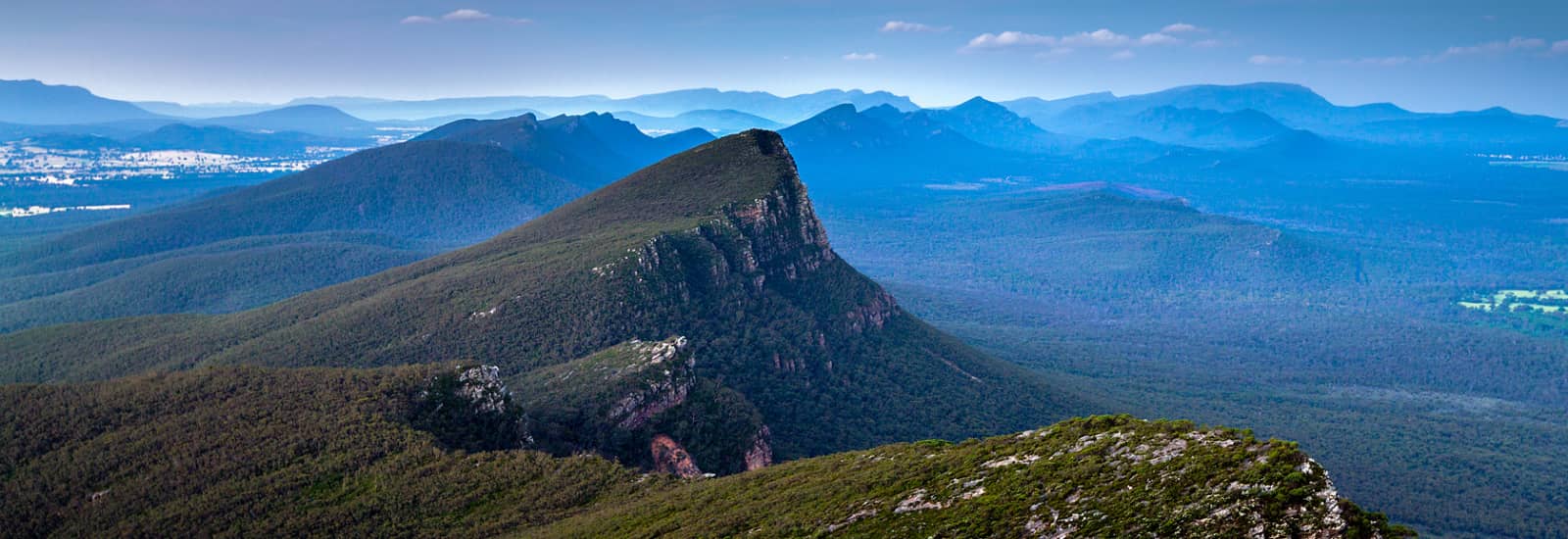
Because you have to talk about the land before you talk about kilometers. The Grampians, or Gariwerd (the name given by the First Nations peoples who have been its custodians for far longer than any other human presence on this continent), look like nowhere else on Earth. Aboriginal peoples have a relationship with this land that goes back more than 30,000 years. Gariwerd sits at the heart of the creation stories of many communities in southwest Victoria. Thirty thousand years. To put that in perspective: the Lascaux cave paintings are about 17,000 years old. The ancient Greeks didn’t exist yet. Modern running as a sporting practice has existed for roughly a century and a half. Gariwerd has the highest concentration of rock art in all of southeastern Australia, with hundreds of sites in the mountain ranges. Billimina is the most prolific rock art site in all of Victoria, with more than 2,000 symbols. So when you pass beneath a sandstone cliff at 3 a.m. with your headlamp and your gels, you’re moving alongside something humanity took millennia to create. Put that in your jacket pocket! 💡 As for European history, it’s a good one too. In 1836, explorer Thomas Mitchell named these mountains after climbing Mount Duwul, the highest point in the range. He chose “the Grampians” in reference to the rugged terrain of his native Scotland, and European settlers arrived soon after, drawn by his glowing reports of the farmland. The GPT100 organizers, for their part, have chosen to systematically pair the two names, Gariwerd/Grampians, in all their communications 🙏. The park itself is a natural extravagance. Grampians National Park spans 167,219 hectares and is also a refuge for kangaroos, echidnas, cockatoos, and emus: animals that couldn’t care less about your race and will cross your trail whenever they feel like it. Australian wildlife has no concept of a “marked zone.” And honestly, that makes things far more interesting. A kangaroo passing you on a descent really puts the ego in perspective! 🦘
Now, how did this race come to be? The GPT100 follows the Grampians Peaks Trail, a 162 km hiking trail established in 2021, originally designed with 12 intermediate campsites to be completed in 13 days on foot. That’s what a normal hiker takes to cross the entire range. SingleTrack Events, the organization behind the race, decided you could do it running, without stopping, with a 50-hour cut-off. It’s either brilliant or completely insane. Probably both at the same time. The first edition was inaugural, the reputation rose quickly, and in 2025, the GPT100 was officially integrated into the World Trail Majors. What makes the GPT100 structurally different from most 100-milers around the world 🌎 is one simple thing: the trail existed before the race. It wasn’t created for a sporting event. It was laid out to showcase all the natural gems of the park, without compromise. So it’s the demands of the terrain that imposed the rules on the race, not the other way around. And you feel it in every kilometer of the route 🏔️.
The “100 Miler Solo” starts early Friday morning from the Mount Zero Picnic Area, at the very north of the range, for 162 km and 7,700 m of elevation gain down to Dunkeld in the south. Eleven aid stations and 99% of the course on pure hiking single track. Zero road, zero compromise. The new thing is the Pairs format: two runners as a team, same course, never more than two minutes apart. A format that turns ultra into a shared adventure—and the most dangerous argument in the world for convincing someone to sign up with you. “Don’t worry, we’ll keep each other company” 😅. For those who want the full experience without leaving both legs out there in one go, the “Stage Race” offers the same 100 miles split over four days, with a return to Halls Gap each evening to sleep in a real bed 🛌. It’s the “calmer” version of the challenge. The “GPT50k” covers the northern section of the trail between Mt Zero and Halls Gap, a full-fledged ultra in its own right—no one gets out unscathed despite the number on the tin. And the “GPT33” is run on the last day of the festival, between the southern peaks: Mud-Dadjug/Mount Abrupt, Signal Peak and Wurgarri/Mount Sturgeon, down to Dunkeld. A great way to get a taste of the Grampians without mortgaging your joints for the whole year 🦵.
The 100-mile course deserves an honest description, because the numbers alone don’t tell the story. It starts with the climb up Flat Rock which suddenly opens onto Taipan Wall, a mythical sandstone cliff in the Australian climbing world 🧗, before diving into a trail that alternates narrow, rocky path, ribbons of soft dirt, waterfalls and 360° views over the whole range 😍. The second section, with its long climbs toward Duwul/Mount William, is experienced mostly at night by most of the pack. That’s where the headlamp becomes your best friend and the kilometers start to weigh heavy. The third passage across the Major Mitchell Plateau, up to the high point of the race at 1,167 m, is officially identified as the heart of the problem—the one where your legs start saying things, and your mind answers “maybe not” 🫣. And the last section, with its stair climbs to the southern summits, is the kind of stretch that makes you want to cry for two opposite reasons at the same time: pain and beauty. At the finish in Dunkeld, a party awaits runners 🎉.
The GPT100 is also a Hardrock 100 qualifier: the American race in the San Juan Mountains of Colorado, considered one of the most selective in the world, which makes it a serious strategic stepping stone for trail runners aiming for the big international stages. The race is also registered with the ITRA and qualifies for the UTMB Index. In terms of prize money, the male solo winner and the female solo winner each go home with 1,620 Australian dollars ! 🤪
The next edition will take place in early November. The race HQ is Halls Gap, the village in the heart of the national park, three hours from Melbourne—far enough to feel like the end of the world, close enough that you don’t have to organize everything a week in advance. The wildlife will be there, the sandstone will glow orange, the eucalyptus will smell of resin warmed by the Victorian November sun, and hundreds of runners will set off northward with the intention of reaching the south 162 km later. It’s big, it’s wild, it’s exactly the kind of race that changes how we see things 🔥.
A distance for every taste
162 kmTOP
49.5 km
33 km
13.8 km
5.8 km
2 km
- 6 Fri ➜ November 8, 2026
- Elevation gain : 7700mD+
- 162 km
162 km : GPT100 Miler
Trail- 6 Fri ➜ November 8, 2026
- Elevation gain : 7700mD+
- 162 km
162 km : GPT100 Stage Race
Trail- 5 Thu ➜ November 8, 2026
- Elevation gain : 7700mD+
- 162 km
162 km : GPT100 Miler
Trail- 6 Fri ➜ November 8, 2026
- Elevation gain : 7700mD+
- 162 km
162 km : GPT100 Stage Race
Trail- 5 Thu ➜ November 8, 2026
- Elevation gain : 7700mD+
- 162 km
49.5 km : GPT50k
Trail- Thu, November 5, 2026
- Elevation gain : 2000mD+ / 2040mD-
- 49.5 km
33 km : GPT33
Trail- Sunday, November 8, 2026
- Elevation gain : 1555mD+ / 1585mD-
- 33 km
13.8 km : GPT 14k
Trail- Thursday, November 5, 2026
- Elevation gain : 700mD+
- 13.8 km
5.8 km : GPT 6K
Trail- Thursday, November 5, 2026
- Elevation gain : 187mD+
- 5.8 km
2 km : Dunkeld 2k Junior Trail
Trail- Sunday, November 8, 2026
- 2 km
Hotels near the race
More info on this race

A next-gen platform helping sports enthusiasts of all levels discover territories and heritage through races tailored to them.
Made in France, between Lyon and Nantes