
L'Étape Trondheim by Tour de France 2027
- Next event : Sat, June 12, 2027Date confirmed
- Last event : Sat, June 13, 2026
The event in a few words
You thought the Tour de France never left France? 🤔
Well, it has headed off to the land of the Vikings, just three little degrees of latitude from the Arctic Circle! 🧭 Every year in June, L'Étape Trondheim by Tour de France unpacks its bags in Trondheim, the third-largest city in Norway and a former Viking capital, nestled on the edge of the fjord in the Trøndelag region. Torvet, the big square in the center, then swaps its laid-back look for a yellow-jersey dress 💛. As for the weather, Trøndelag happily serves up all four seasons in a single day 🌦️: slip sunscreen and a windbreaker into your back pocket, they'll end up getting along 🧥.
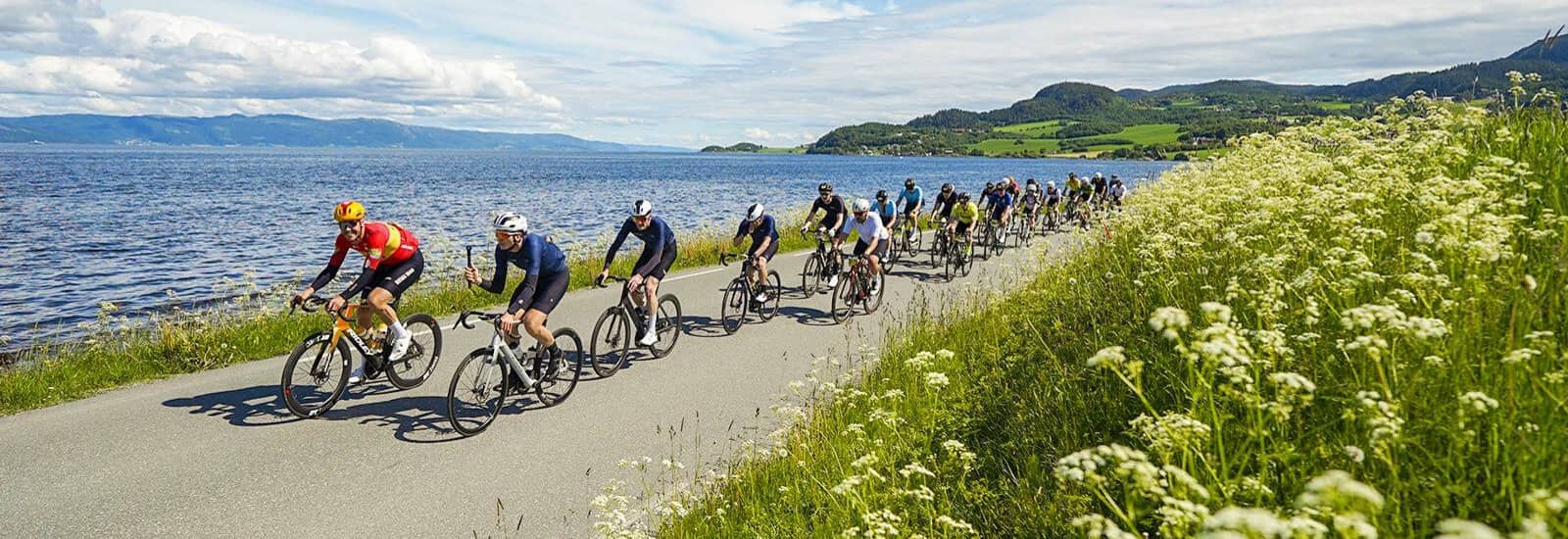
On the menu, two cyclosportives of medium distance, 75 km and 130 km, on fully closed roads, with start and finish on Torvet. The peloton leaves the city in a neutralized procession through the downtown streets, then heads west along the seaside of the Trondheimsfjord, where the Tour de France quickly turns into the Tour de Fjord 🌊. The first showdown comes at the Grøset climb: pronounce it however you like, it's always climbed the same way, out of the saddle ⛰️. The road then rolls through open nature, between meadows, red farmhouses and fir forests 🌲, facing the Gaulosen estuary, enough to put your morale in great shape… and your calves to work. The long course pushes on to Skaun, Melhus and Klæbu, three villages that your GPS will pronounce better than you 😅. Expect 1,058 mD+ on the 75 km and 1,570 mD+ on the 130 km: no high mountain pass on the horizon, rather a leg-breaking terrain that never leaves your thighs in peace 🦵.
Born in 2026, L'Étape Trondheim by Tour de France belongs to the L'Étape Series family, the international circuit of cyclosportives bearing the Tour de France stamp, just like its Viking neighbor L'Étape Denmark. Here, you'll ride like a pro: neutralized start behind the official car 🚗, kilometer zero, intermediate sprint, timed climbs and yellow, green and polka-dot jerseys up for grabs. Cherry on the handlebars 🍒, the event remains the only cycling race in Norway held on closed roads: not a single oncoming car, only Vikings on bikes, minus the axe and plus the calves 💪. The best finishers of the long course earn their place at L'Étape du Tour de France, turning a Nordic jaunt into a ticket to the most famous of cyclosportives. Families are not forgotten with the Mini L'Étape, 500 m of happiness on Torvet for children aged 3 to 12 🚲.
After the effort, Trondheim is best enjoyed… by bike, of course. In the colorful Bakklandet district, Trampe, the world's first bicycle lift, hoists cyclists to the top of Brubakken street 🛗: climbing a hill without pedaling, just don't tell your legs. The Nidaros Cathedral deserves a pit stop ⛪, before a souvenir photo on the old red Gamle Bybro bridge 📸. As for the plate, recharge your glycogen with a sodd, the festive soup of Trøndelag 🍲, and leave the karsk, a local blend of coffee and homemade moonshine, to the most thirsty and fervent supporters 🥃. On Torvet, the statue of Olav Tryggvason, the city's founder, watches over the finish line from atop his column: a Viking king to applaud you in the sprint, you can't turn that down 👑.
So, ready to do the Tour… of the fjord? Miss out on this? You'd be Torvet-ally wrong! 🏁
4 reasons to join this race
A distance for every taste
130 kmTOP
75 km
500 m
- Saturday, June 12, 2027 at 11:00 AM
- Elevation gain : 1570mD+
- 130 km
A few more words
Same opening as the 75 km: neutralized start from Torvet, the Grøset climb around km 14 🏔️, the Byneset bumps, the Spongdal feed zone and the Nypan sprint around km 40. At Klett, turn right: the long course heads west along the fjord through Buvika to Børsa, about fifteen km of almost flat road where it's best to stay well sheltered in the wheels 🌬️. At Børsa, the road gives way to a trail, a short descent and a narrow wooden bridge with tight turns 🪵. Then begins the longest climb of the day, from sea level around km 55 up to roughly 220 m around km 66, with the gravel sector between Børsa and Eggkleiva and then the Venn climb, a timed category 4, with views over Lake Malmsjøen. Like the diagram of the same name, it sits right at the intersection of pain and pleasure 📐. A slightly rolling plateau leads to Vassbygda, before the descent to Melhus and its feed zone, around km 80.
The final part packs in most of the elevation gain. After the tight turns toward the Gimse bridge and two level crossings (here, even the peloton respects the train schedules 🚆), the road climbs steeply back up to roughly 230 m around km 89, heading for Tanem. The profile then stays perched between 150 and 200 m all the way to Klæbu, one letter away from the name of Johannes Høsflot Klæbo, the Trondheim native turned king of cross-country skiing ⛷️. The bonus loop toward Brøttemsmoen then holds the decider: the Ståggån climb, the roof of the course at around 280 m near km 105, a name that sounds like a curse word at the end of a race, which is rather fitting for emptying the tank 🔋. What remains is a long descent through Bratsberg and the Nidelva valley, one last bump around km 117, then Sluppen, Lerkendal and a triumphant finish on Torvet 🎉. Little secret: on the odometer, the long course actually shows 128 km 🤫, two km saved for the finish meal.

75 km : Road Cycling 75 km
Road Cycling- Saturday, June 12, 2027 at 11:00 AM
- Elevation gain : 1058mD+
- 75 km
A few more words
It all starts on Torvet, at the foot of the Viking king's column. The first 2.2 km are ridden neutralized along Sandgata and Kongens gate, then along Ila, where the tram tracks demand caution 🚋: no way you're derailing right from the start. Once kilometer zero is crossed, the road follows the fjord westward to Flakk, with a first bump around km 5 to warm up the legs. Around km 14, the Grøset Climb rises to about 170 m in elevation: category 3, timer on, first hunt for the polka dot jersey 🧗. The descent tips down toward Rye and the southern shore of the Byneset peninsula, where two more bumps, around km 25 and 29, turn the road into a little roller coaster 🎢. The Spongdal aid station comes at just the right time before a rolling, almost flat section along the Gaulosen estuary, ideal for catching your breath. Around km 40, the Nypan sprint, 300 m flat out 🔥, crowns the king of speed.
Things get tougher from there: right after Nypan, the road climbs to the highest point of the course, about 220 m around km 46, with a short gravel section along the way between Leinstrand and Røddevegen, a chance to taste Norwegian-style gravel 🪨. The profile then remains hilly, between 100 and 160 m in elevation, up to Tanem where the two courses join, then climbs toward Klæbu and the Lysklett school aid station 🥤. A small loop south of Klæbu precedes a final bump around km 66, before the long descent through Bratsberg and the Nidelva valley down to Sluppen. The final kilometers, technical ones, wind around the Lerkendal stadium 🏟️, home of Rosenborg BK, where you too will play extra time until the final sprint on Torvet. On the clock: about 76 km with 1,058 mD+.

500 m : Family Ride
Road Cycling- Saturday, June 12, 2027 at 11:30 AM
- 500 m
Frequently asked questions (FAQ)
Bibs can be collected at the Race Village set up on Torvet, Trondheim's central square, on Friday, June 11, 2027 and Saturday, June 12, 2027. Opening hours will be announced later. Registration remains open until 7 p.m. on Friday, June 11, 2027.
All starts take place on Saturday, June 12, 2027 on Torvet, in the center of Trondheim:
130 km: start at 11 a.m.
75 km: start at 11 a.m.
Mini L'Étape (500 m): start at 11:30 a.m.
Start waves are formed according to the average speed estimated at registration, not according to distance. The first digit of the bib indicates the wave number, and the fastest waves start first.
A license is required to take part: either an annual license from the Norwegian Cycling Federation (Norges Cykleforbund), or a one-day license costing 220 NOK, purchased at the time of registration. This license includes accident insurance.
The minimum age varies depending on the format:
130 km and 75 km: 17 years old.
Mini L'Étape: from 3 to 12 years old.
The early bird rates are as follows:
130 km: 1,190 NOK solo, 2,180 NOK for a duo.
75 km: 990 NOK solo, 1,780 NOK for a duo.
The duo pass offers a discount, with no obligation to ride together.
The 130 km has a time limit of 7 hours. 2027 info to come for the 75 km.
The course has four aid stations:
Spongdal, on the 75 km and the 130 km.
REMA 1000 Gaula, on the 130 km only.
Lysklett School, on the 75 km and the 130 km.
Finish area, for all participants.
The license is mandatory, as is wearing a helmet.
Registration includes:
A personal bib and a welcome pack.
Access to the baggage drop and bike parking.
Closed and secured roads along the entire course.
Medical assistance as well as fixed and mobile mechanical assistance.
Aid stations and official timing.
Participation in the sprint and climber rankings, with official Tour de France jerseys up for grabs.
Return transport to the finish in case of withdrawal.
A finisher medal and a post-race meal.
Access to the finish area, its entertainment and the official results.
Access to an exclusive registration period for L'Étape du Tour de France.
The pasta party and the post-race party are paid and sold separately.
A baggage drop is available to all participants. The tag is handed out with the bib, and the last digit of the bib indicates the bin in which to drop your bag. Bike parking is also provided. 2027 info to come regarding showers and changing rooms.
The start and finish are located on Torvet, Trondheim's central square. Trondheim-Værnes Airport is connected to the city center by train and shuttle [TO BE VERIFIED]. Traffic restrictions are in place around the course on race day. All information on transportation and accommodation is available on the dedicated page of the official website.
The organizers can be reached by email at contact@letape.no or via the contact form on the official website.
Applications are made via the volunteer page of the official website.
A next-gen platform helping sports enthusiasts of all levels discover territories and heritage through races tailored to them.
Made in France, between Lyon and Nantes