

Roma Appia Run 2027
- Next event : Mid-April 2027
- Last event : Sun, April 19, 2026

The event in a few words
Putting on a bib in Rome is a bit like taking a trip back in time without needing a complicated machine, just a good pair of shoes 🏃.
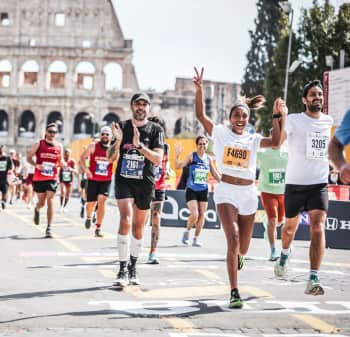
Located in the capital of Italy, in the heart of the Lazio region, the Roma Appia Run has established itself as a mythical mid-April event. Over a weekend 📆, the event turns the eternal city into a vast playground for road and history enthusiasts 🏛️. The organization offers two main formats: the queen race of 19.950 km for competitors and amateurs, as well as a 9 km loop. But what does "Appia" mean in Italian? 🇮🇹 Well, it actually means "flat"! ☝️ Yet, the courses you will discover are not 100% flat, so you'll need to adapt to the terrain 💪.
This is not just a urban jog, but an legendary course 🤩. From the Colosseum to the Circus Maximus 🤯, through the Porta San Sebastiano, a visually impressive and emblematic monument, or even through the Caffarella Park 🌳 and the San Callisto catacombs 🦴. The route is renowned for its five types of terrain that will test your ankles 👟. You'll successively tread on classic asphalt 🛣️, the famous "basolato" (historic volcanic stone slabs 🌋), the "sampietrini" cobblestones, the earth paths of the Parco della Caffarella, and finally the synthetic track for a grand finale 🤩. The route will take you along the Via Appia Antica, a true backbone of the Empire 👑, passing by the mausoleum of Cecilia Metella and the Quo Vadis church ⛪️. It's rugged, it vibrates under your heels, but each stride on these millennia-old stones reflects the technical challenge of this historic ground 🤓.
On the atmosphere side 🎉, the event gathers an army of volunteers to support a sea of people eager to defy centuries 😎. The race village, set up at the Stadio delle Terme di Caracalla 🏟️, becomes the meeting point for runners from all over Europe 🌍. Along the route, the cheers of the Romans stationed at the gates of the archaeological parks will give you the necessary boost not to collapse before reaching the finish 😂. The organization focuses on a typical Italian conviviality 🤌 with strategic refreshments and a bustling exhibitors' village 🤪.
Your weekend doesn't end at the finish line 🏁, and we suggest making the most of the post-race period for a complete local immersion 📍. You can explore the Catacombs of San Callisto, located just steps from the course, or choose a more peaceful stroll in the Parco Regionale dell'Appia Antica 🏞️ to admire the Roman aqueducts. For families, a visit to the Museo delle Mura at the Porta San Sebastiano offers an unusual view of the city's fortifications. If your legs crave some relief 🦵, the Villa Borghese gardens are a must for a well-deserved nap in the shade of the umbrella pines 🌲. Avoid overexerting yourself with a tour of the Colosseum right after the race; your calves will thank you during the journey back 😝.
Ready to enter the arena and come out victorious? 🏅
5 reasons to join this race
A distance for every taste
19.5 kmTOP
9 km
- Mid-April 2027
- 19.5 km
A few more words
Here we tackle the big part of the day 💪, the long format that ties pure performance to the history of the city 🏃.
This 19.950 km course starts explosively at the Stadio delle Terme di Caracalla 🏟️. You quickly leave the modern asphalt to join the Via Appia Antica, where you face the famous "basolato". These huge ancient volcanic stones 🌋 require constant vigilance to avoid twisting an ankle 👟. A terrain worthy of a trail prep 😂. The course then takes you to the Mausoleum of Cecilia Metella before veering towards the Parco della Caffarella 🌳. In this green lung, you radically change scenery and sensation with earthen paths and stretches of short grass 🌿. You finish with a tense portion on the Via Ardeatina before returning to the synthetic track of the stadium for a final sprint worthy of the greatest ancient athletes 🏟️.
19.5 km : Course sur route 19,5 km - Non compétitive
Road Running- Mid-April 2027
- 19.5 km
9 km : Road Running 9 km
Road Running- Mid-April 2027
- 9 km
A few more words
For those who prefer a shorter but equally intense effort ⚡️, the 9 km route offers a condensed version of the Roman experience ⚔️.
We share the start with the 19.950 km pack, which guarantees an electric atmosphere from the very first strides 💪. You enjoy the technical passage on the "sampietrini" cobblestones and a section on Via Appia Pignatelli 🛣️, offering a perfect glimpse of the diversity of surfaces 🤓. The route remains very dynamic with constant restarts that break the rhythm and prevent monotony 🤪. We pass through wooded areas and nearby archaeological sites before heading back to the baths ⛲️. This is the ideal format if you want to go big on an accessible distance while still having enough energy to explore the city's museums for the rest of the day 😉.
9 km : Course sur route 9 km - Non compétitive
Road RunningFrequently asked questions (FAQ)
The races will start at the Stadio delle Terme di Caracalla on April 19, 2026, at 8:30 AM.
For the 19 km: 30€
For the 9 km: 20€
As a foreign runner, you can run in the non-competitive category. Thus, you will not need to provide a medical certificate or a Runcard. You will simply need to fill out a waiver on site when collecting your bib.
For your information, 99% of foreign runners participate in the non-competitive category. You will have an official time and will start in the same corrals as the so-called competitive runners.
If you prefer, you can run in the competitive category. This category is primarily reserved for Italian runners, elite athletes, and those aiming for a podium finish. You will have an official time and be ranked among Italian runners, athletes, and others in the competitive category. To run as a competitive athlete, you must provide a medical certificate. In addition to the medical certificate, you must provide either a 2025/2026 FFA license or a Runcard. The Runcard is an Italian license that costs 15 euros, allowing a runner not affiliated with an athletics federation to compete in the competitive category. It can be purchased on the website www.runcard.com.
If you want to learn more about the Runcard, click on this link to read an article detailing how this card works for racing.
If you have any further questions, you can contact the organizers by email: info@appiarun.it
Focus


More info on this race


A next-gen platform helping sports enthusiasts of all levels discover territories and heritage through races tailored to them.
Made in France, between Lyon and Nantes