
Culture and History Races

Upcoming Culture and History races

 Bangkok
 Rennes(35)
 Toubakouta
 Ürgüp
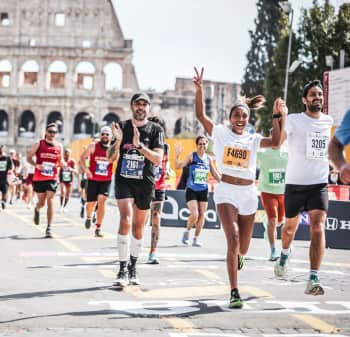
ÜrgüpA free, open-air museum that you get to traverse at a run: that’s, in a nutshell, what a Culture & History race is 🏛️. Here, kilometer 12 goes past a fortress, the 20 runs along a battlefield, the 30 cuts through a thousand-year-old medina. No audio guide needed: the scenery speaks for itself, and every stride becomes a history lesson you don’t even notice going by. Some races even make you change centuries without changing pace, between Roman ramparts and Second World War bunkers.
There’s something a little dizzying about running on ground that has seen far more people than you pass by—often in far more dramatic circumstances 📖. That’s the whole point of a Culture & History race: the course has a story to tell even before you’ve pinned on your bib. You’re not just crossing a territory—you’re crossing its scars, its rebuilds, sometimes its tragedies, and it completely changes the way you run.
In Langrune-sur-Mer, the Littorale Juno didn’t get its name by chance 🎖️. Juno Beach is one of the five beaches where Canadian troops set foot on June 6, 1944, alongside the British and the Americans, in what remains one of the most decisive military operations of the 20th century. Along these 7 km, the bunkers of the Atlantic Wall are still standing—remnants of a German defensive system that once stretched for more than 5,000 kilometers of coastline. Hard to run here without thinking about it at least a little.
This kind of course isn’t experienced like a classic race. Your gaze—constantly snagged by a sign, a ruin, the silhouette of a monument—tends to drift away from the clock ⏱️. And the difficulty doesn’t always come from the elevation gain: it comes instead from that irresistible urge to slow down and look, or from the cobbled lanes of old town centers that abruptly break your stride rhythm 🏰. Some runners even admit they run these routes a second time, purely to take the time to look at what they sped past too quickly the first time.
In Italy, in Duino, on the Adriatic coast, the Sardon Run climbs beneath a castle that welcomed, in 1912, a rather special guest 🖋️: the Austrian poet Rainer Maria Rilke, hosted by Princess Marie of Tour and Taxis, who composed there the beginning of his famous Duino Elegies. The limestone cliffs you run along were shaped by erosion over millions of years—and trodden long before Rilke by Roman legionaries tasked with watching over this strategic stretch of the Adriatic. From poetry to the borders of the Empire, all on a single coastal trail.
The ground tells very different stories depending on where you set foot. A European medieval town center imposes its narrow, cobbled alleys, originally designed for defense rather than traffic—slippery in the rain, without exception. A medina in North Africa, on the other hand, unfolds a shaded, covered maze, designed a thousand years ago to protect from heat rather than invaders, with sometimes uneven ground that requires a bit of attention.
That’s exactly the vibe of the Trail Désert Agafay Marrakech 🐫, which runs alongside the medina before plunging into the Agafay Desert. This medina, founded in the 11th century by the Almoravid dynasty, is home to souks listed as a UNESCO World Heritage site, where you still pass tanners and grocers settled there for generations. Then, without transition, asphalt gives way to the dunes and red rocks of the desert, where trade caravans once traveled between Marrakech and Sub-Saharan Africa. Few races offer such a dramatic change of scenery in so few kilometers.
Back to Central Europe with the Birell 10k Night Race Prague 🌙, which sends runners onto the Charles Bridge. Built starting in 1357 on the orders of Emperor Charles IV to replace a bridge swept away by a flood, it still bears its baroque statues that watch, impassive, over runners at night. A little further on in the capital, the Old Town Astronomical Clock has been turning without interruption since 1410 (the oldest still in operation in the world) and continues to stage its mechanical procession of the apostles on every hour. At night, between cobblestones gilded by streetlights and baroque stone, the course feels like a movie set.
In Budapest, the Wizz Air Half Marathon 🌉 links two banks that long lived side by side: Buda and Pest officially merged only in 1873, after centuries of eyeing each other warily across the Danube. The course runs along the Hungarian Parliament, a neo-Gothic building completed in 1904 and directly inspired by the Palace of Westminster, then crosses the Chain Bridge, the river’s first permanent bridge built in 1849—an engineering feat that embodied, well before institutions did, the city’s reunification.
All these races have one thing in common, whether they take place in Normandy, in Veneto, or in the Moroccan desert 🌍: they bring to life what elsewhere would remain frozen behind museum glass or a tourist sign. Each monument you pass carries a rupture, a rebuilding, sometimes a rebirth—and it gives these routes an extra soul that few other themes can claim.
And history doesn’t stop at the finish line 🥘. Many of these events extend the experience right onto the plate 🍽️: mint tea and honey pastries on the Moroccan side, blonde beer and warm trdelník on the Czech side, steaming goulash on the Hungarian side. Some organizers even take it as far as dressing up their volunteers in period costume, to blur the line even more between historical reenactment and running.
Want to extend the experience between stone and effort? Head to the castle races 🏰, to swap medinas and battlefields for turrets and moats of medieval and Renaissance castles.
 See all races
Plan your next Culture and History race
Where to run at the heart of culture and history?













Other themes are waiting for you






















A next-gen platform helping sports enthusiasts of all levels discover territories and heritage through races tailored to them.
Made in France, between Lyon and Nantes