Races in Apulia

vincydesy
Upcoming races in Apulia




The heel that doesn’t drag its feet
Sun in February, olive trees everywhere, and two seas just for you. In the heel of the boot, you run flat, by the water, with burrata waiting for you at the finish 🌊
Take a map of Italy, head down to the heel: you’re there. Apulia stretches four hundred kilometers from north to south, wedged between two seas, and no one crosses the region without ending up with salt on their skin. Bari sets the tone: a port facing Albania, alleyways where grandmas roll orecchiette outside their homes, a seafront that seems to go on forever. Lecce plays a different tune with its golden Baroque, carved from a stone so soft that sculptors could work it with a knife. Taranto has lived between its two inland seas since the Greeks. Foggia keeps watch over the Tavoliere wheat fields. And Barletta leaves its bronze colossus standing in front of the basilica, as if it’s been waiting for someone for eight centuries 🇮🇹.
Good news for your legs: it rarely climbs. The Murge form a gentle limestone plateau, riddled with caves, including those of Castellana that run seventy meters underground. A bit further south, the Itria Valley brings out its trulli, those little round houses stacked without a drop of mortar; Alberobello turned them into an entire town. The only place that really climbs is the Gargano, way up north: a wooded spur that drops into the Adriatic in white cliffs, with centuries-old beeches on the plateau 🌲. The rest is olive trees. Thousands of them. Some are a thousand years old, with hollow, twisted trunks, and they stream by in rows to the horizon as you rack up the miles.
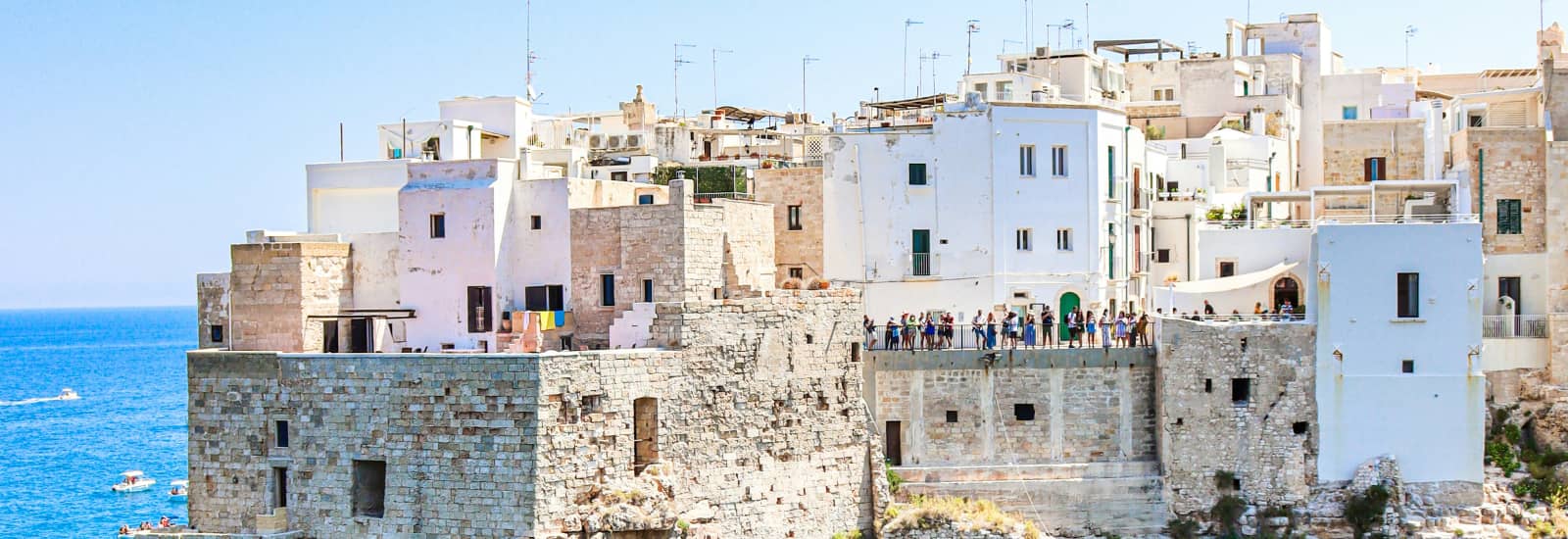
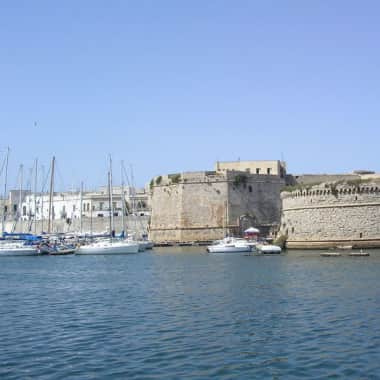
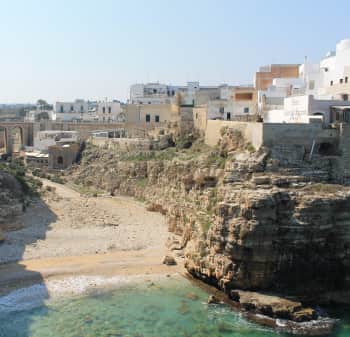
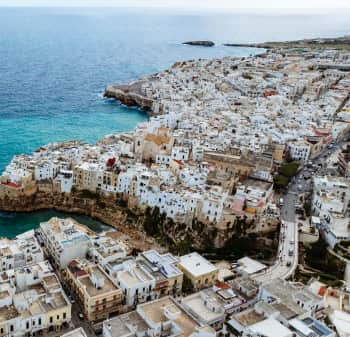
The coast, for its part, is worth lingering on. Polignano a Mare balances its houses above a cove, Ostuni repaints its hill in whitewash every year, and the Salento rolls out fine sand all the way to Gallipoli and Otranto — the easternmost town in the country, where the sun rises before anywhere else in Italy. Seaside outings come with an almost constant tailwind (or a headwind, depending on your direction) 🏖️. One tip, though: avoid July and August. It’s thirty-five degrees, not a cloud in sight, and even the locals wait until evening to go out. The sweet spot runs from September to May, and winter stays so mild you can run in short sleeves in February. Few regions in Europe can say the same ☀️.
The race calendar in Apulia stretches from one end of the heel to the other. The Bari Med Marathon kicks off February along the seafront. The Strataranto cuts through Taranto in April, from the old town on its island to the shipyards. The Acaya Half Marathon loops in March around a 16th-century fortified town lost in the Salento. The Leccerun takes you past Baroque facades in October. The Run For Foggia heads out onto the plains in spring. In late September, the Trail dei Vigneti takes you among the vineyards of Gallipoli, while CUTPUGLIA offers the toughest slice of the area starting from Castellaneta. Right in the middle of August, the CiccioRiccio Run bets everything on the party in San Pietro Vernotico 🎉. For triathletes, meet up at the Trani Triathlon, in front of a cathedral set with its feet in the water, or at the Adriatic Series in Vieste beneath the Gargano. If you want to push further, Matera and its sassi are an hour from Bari, in Basilicata, and Calabria starts just below.
After a race in Apulia, you won’t leave with an empty stomach, let’s be clear. Orecchiette with cime di rapa is the house specialty. Andria’s burrata runs the moment you cut into the ball. Focaccia barese with cherry tomatoes is eaten warm, standing up, and disappears fast 🍅. The region produces almost half of Italy’s olive oil, so it’s safe to say nothing arrives dry on the plate. A glass of Primitivo di Manduria to finish, if you feel like it (Alcohol abuse is dangerous for your health; consume in moderation). On the sports side, everyone here will talk to you about Pietro Mennea. The kid from Barletta, nicknamed the Arrow of the South, took gold in the 200 meters in Moscow in 1980 and held the world record for seventeen years. Seventeen years 🥇. In another genre, Domenico Modugno was born in Polignano a Mare, and his song Nel blu dipinto di blu ended up making the planet sing under the name Volare 🎤. Add Renzo Arbore, a man from Foggia who dusted off Italian TV, and you’ve got the trio. So, Baroque cobblestones or Salento sand for your next bib? Take a look at the local half-marathons and 10K races: your winter in the sun starts here 👟.
 See all races
Race calendar in Apulia
These great running spots might also interest you




Other places are waiting for you




A next-gen platform helping sports enthusiasts of all levels discover territories and heritage through races tailored to them.
Made in France, between Lyon and Nantes